Montauk "Fall Run" Fishing Report: The Mecca of Northeast Saltwater Angling
The legendary autumn migration is in full swing at "The End." Montauk is currently living up to its reputation as the epicenter of the Northeast fall run. With cooling water temperatures pushing baitfish out of the bays and pelagics moving south, the waters surrounding Montauk Point are boiling with predatory activity. Whether you are surfcasting under the lighthouse or drifting the rips in a center console, the sheer volume of biomass right now is staggering. Here is your comprehensive tactical breakdown for capitalizing on the current conditions.
1. GO/NO-GO STATUS
Verdict: CAUTION - WEATHER DEPENDENT GO
The fishing is spectacular, but autumn in Montauk requires utmost respect for marine conditions. Small craft advisories are common this time of year as cold fronts push through, creating volatile wind shifts from the northeast to the northwest. The clash of a strong outgoing tide against a stiff northeast wind will stack up dangerous, closely spaced swells at the Point and in the Montauk Channel.
🎣Nautrek
Private Beta
J
M
R
100+ anglers on the waitlist
The fishing network where your reputation matters.
Find trusted captains, join real trips with cost splitting, and build your Angler Rank. Your spots stay private — you decide who sees your intel.
Safety Advisory: If you are navigating the inlet or fishing the outer rips (Great Eastern or Southwest Ledge), monitor the wind-against-tide conditions closely. The "mosquito fleet" of light-tackle boats should stick to the calmer waters along the south side or inside Gardiner's Bay if the wind exceeds 15 knots. Surfcasters should wear studded wading boots and a tightly secured surf belt, as the sweeping currents and rogue waves around the lighthouse rocks take no prisoners.
2. SPECIES INTEL
Primary Targets: Striped Bass and False Albacore
The stars of the fall run are sharing the stage. Striped bass (both schoolies and slot-sized fish) are intercepting bait schools moving along the shoreline and over the nearshore reefs. Meanwhile, False Albacore ("albies") have invaded the rips in massive numbers, providing world-class light-tackle and fly-fishing opportunities. The albies are highly aggressive right now, feeding in chaotic, fast-moving surface blitzes.
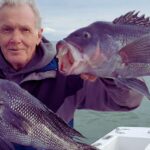
Sleeper Pick: Jumbo Black Sea Bass
While everyone is burning fuel chasing bird activity on the surface, incredible bottom fishing is being completely ignored. Massive Black Sea Bass are holding on deeper structure and wrecks in the 60 to 80-foot range. Because the fleet is distracted by pelagics, these deep-water humps are untouched, yielding limit catches of knuckle-head sea bass.
Baitfish Report
The waters are thick with a diverse forage base. The primary bait driving the current surface feeds is Bay Anchovies (rain bait), which are pouring out of Gardiner's Bay. We are also seeing pods of Peanut Bunker (juvenile menhaden) getting pinned against the beaches, along with slender Sand Eels holding in the sandy troughs along the south side. Matching the hatch to these specific bait profiles is critical for success.
3. TACTICAL STRATEGY
Where to Deploy
For the Boat Angler: The rips off Montauk Point—specifically Great Eastern and Washington Shoal (the rocky hump between the inner and outer Shagwong reefs)—are holding massive schools of bass and albies. If the fleet is too thick at the Point, push slightly west toward the radar tower shoreline or make the run to the Southwest Ledge off Block Island for larger, solitary striped bass.
For the Surfcaster: The coves and rocky points right under the Montauk Lighthouse are prime. Focus on the sandy troughs and cuts along the south side beaches (like Ditch Plains) during the outgoing tide, as bait gets sucked out of the shallows and delivered directly to waiting stripers.
Lure & Bait Selection
False Albacore (Light Tackle): Throw a 7/8oz or 1oz epoxy jig (like the Hogy Epoxy Jig or JoeBaggs Resin Jig) in Bone, Silver, or Olive. The clear/silver patterns perfectly mimic the translucent bay anchovies.
Striped Bass (Surface/Blitz): A 1.5oz to 2oz Diamond Jig (A47 with a green surgical tube tail) is a Montauk staple. For topwater excitement, a 2.5oz pencil popper in white or yellow will draw explosive strikes from larger bass shadowing the peanut bunker schools.
Striped Bass (Bottom/Night): Drifting live eels on a 3-way rig through the rips at night remains the undisputed champion tactic for cow stripers. Use a 6/0 to 8/0 inline circle hook (mandatory by law).
Black Sea Bass (Sleeper): Drop a 3oz to 4oz flutter spoon or a heavy bucktail tipped with a Berkley Gulp! Swimming Mullet (Chartreuse or Glow) over the deeper rock piles south of the point.
Timing the Bite
The most explosive surface feeds for albies and schoolie bass are occurring during the first two hours of the outgoing (ebb) tide, especially when this aligns with dawn or dusk. The falling water flushes bait out of the bays and into the turbulent rips, creating a natural chum slick. If you are hunting trophy striped bass with live eels, the dark of the moon during a sluggish tide phase is your best window.
Pro Tip: When approaching a chaotic False Albacore blitz, never run your outboard directly into the breaking fish. This will immediately push the school down. Instead, determine the direction the fish are moving, run wide of the school, cut your engine, and drift silently into their path. A stealthy approach yields ten times more hookups than running and gunning.
Pro Tip: When surfcasting the rocks, keep your rod tip high as your lure nears the shoreline. Striped bass will often follow a bucktail all the way to your feet and strike in the final two yards of the retrieve right where the wave breaks against the structure.
4. REGULATIONS SNAPSHOT
Enforcement is heavy during the fall run. New York State Department of Environmental Conservation (NYSDEC) regulations for the marine district are strictly enforced. Note that inline circle hooks are absolutely required when fishing for striped bass with bait.
Species
Size Limit
Bag Limit
Season / Notes
Striped Bass
28" to 31" Slot Limit
1 fish per angler
Open until Dec 15. Circle hooks mandatory for bait.
False Albacore
No size limit
No bag limit
Open year-round. Catch and release highly encouraged.
Bluefish
No size limit
3 fish (Private) / 7 fish (For-Hire)
Open year-round.
Black Sea Bass
16" Minimum
6 fish per angler
Current fall/winter regulations (Sept 1 - Dec 31).
5. REGIONAL ALTERNATIVE
If howling northeast winds make Montauk Point unfishable and dangerous, do not force the issue. Pack up and drive west to Shinnecock Inlet or Orient Point.
Orient Point offers excellent lee protection on a northeast blow. You can access Plum Gut via the Orient Point County Park. The Gut features massive tidal currents and holds fantastic numbers of striped bass and bluefish. Cast 2oz to 3oz bucktails (white with a red thread wrap) tipped with a pork rind substitute into the eddy lines. Let the lure sink to the bottom and utilize a slow, bouncing retrieve to trigger strikes from bass holding behind the submerged boulders.
Alternatively, Shinnecock Inlet provides sheltered bay access where you can target striped bass working the marsh edges and bridge pilings away from the ocean swells.
Tight lines!
Editor's Choice: Must-Have Gear
FISHINGSIR Next-Gen Waterproof Chest Waders
★★★★★4.4 (7,370+ reviews)
2-Ply Tech: Upgraded nylon with 2.5x higher density than standard fabrics.
100% Waterproof: Lab-approved intrusion resistance with taped visible seams.
Ultra-Lightweight: Designed for all-day comfort while hunting or fishing.
As an Amazon Associate I earn from qualifying purchases. #ad
Loading forecast...
Live Fishing Conditions: Tides, Weather & Waves
Get real‑time tides, marine weather, swell and solunar activity for each spot so you know exactly when conditions line up for your best chance at a bite.
🎣
Montauk
Loading coordinates...
🌤️
WEATHER CONDITIONS
--°F
--°C
Loading...
🌡️
Feels Like--°F--°C
💧
Humidity--%
💨
Wind-- mph-- km/h
🧭
Direction--
📊
Pressure-- inHg-- hPa
☀️
UV Index--
🌊
MARINE CONDITIONS
🌊Wave Height
-- ft
-- m
Loading...
🧭Wave Direction
--°
Loading...
⏱️Wave Period
-- s
Loading...
📈Tide Status
-- ft
-- m
Loading...
🌙
LUNAR & SOLUNAR
🌕
Loading...
Illumination: --%
Major Period--:-- - --:----:-- - --:--
Minor Period--:-- - --:----:-- - --:--
🌅Sunrise--:--
🌇Sunset--:--
📅
24-HOUR FORECAST
Loading fishing conditions...
Fishing Spots Map
🎣
Book a Fishing Charter near Montauk Fishing Report Today 🎣
Local guides & charters. Verified captains, instant booking, best price guaranteed.
There was an error loading the map. Please try refreshing the page.
Info
Local Access & Facilities
The End of the Line: Fishing Montauk
Montauk, often referred to simply as "The End," represents the ultimate convergence of land and sea for New York anglers. Situated at the easternmost tip of Long Island, this fishery is defined by its rugged coastline, sweeping bluffs, and the collision of Atlantic currents that create a nutrient-rich ecosystem. The atmosphere here is distinct from the manicured lawns of the Hamptons to the west; it is raw, salt-worn, and entirely dedicated to the pursuit of game fish.
The topography is characterized by a mix of sandy stretches and rocky structures, with areas like the Amagansett National Wildlife Refuge showcasing unique double dune systems rarely seen elsewhere. For the boat angler, the water drops off quickly into the deep Atlantic, while surfcasters patrol the rocky shorelines that fringe the peninsula. The vibe is serious and historic, echoing decades of sportfishing heritage where the Atlantic Ocean meets Block Island Sound.
Prospective anglers flock here primarily for the legendary runs of striped bass, bluefish, and false albacore that blitz the shoreline during the migration. Whether you are launching a heavy center console to head offshore or wading the suds with a surf rod, Montauk offers a dynamic and challenging environment that demands respect and preparation.
Access & Getting There
Reaching Montauk requires a commitment to travel, as it sits at the very terminus of Route 27 (Sunrise Highway). During the height of the summer season, traffic on this single artery can be brutal, with significant congestion building up through the Hamptons. Seasoned captains know to time their arrival for the pre-dawn hours, not only to catch the bite but to beat the gridlock that forms by mid-morning.
For those trailing boats, the drive requires vigilance. Once you pass East Hampton, the road narrows and winds through rolling hills. There are several launch points available in the area. The data indicates three distinct boat ramps in the immediate vicinity, suitable for trailer parking. However, access points can be tide-dependent. It is crucial to check the specific ramp conditions, as some local launches can become slick or shallow during extreme low tides.
💡 Captain's Tip: Beat the Traffic
Route 27 is the only way in or out. Plan to cross the Shinnecock Canal well before 6:00 AM to avoid the "Hamptons crawl." If you are trailering a wide beam vessel, early transport is mandatory to navigate the narrower sections of the highway safely.
Parking is a critical logistical component in Montauk. The Montauk Station offers a reliable landmark and parking area roughly 0.8 miles from the central fishing zones. For those looking to access the shoreline via state lands, the Shadmoor State Preserve Trail Parking is located approximately 1.2 miles away. Anglers with recreational vehicles should head to the Montauk County Park, RV Beach Parking, situated about 3.1 miles from the main hub, which provides ample space for larger rigs.
Weather plays a massive role in accessibility here. The point is exposed to the open Atlantic. When strong easterly winds whip up, the ocean side becomes unfishable and dangerous for small craft. In these conditions, smart anglers retreat to the leeward side or explore the protected waters of the nearby wildlife refuges, though access there may be restricted to shore fishing or kayaking.
Montauk Pre-Trip Checklist
Facilities & Amenities
Montauk's infrastructure is built around the fisherman. The local shops are specialized and understand the "dawn patrol" schedule. A standout facility is Westlake Bait & Tackle Shop, located 2.3 miles from the center. This shop is a staple for the fleet, opening its doors at 5:00 AM daily to ensure you have fresh bait and ice before the sun breaks the horizon. Closer to town, Cool Gear Fishing offers additional support just under a mile away.
For those needing gear repairs or specialized tackle further up the island, Greenie Supply & Tackle in Southold operates 24 hours a day, though it is a significant drive (23.5 miles) and better utilized as a stop on your way in or out. The table below outlines the key logistical hubs for anglers in the immediate region.
Facility Name
Type
Distance
Key Notes
Westlake Bait & Tackle
Bait & Tackle
2.3 miles
Opens 5:00 AM. Hub for local intel.
Cool Gear Fishing
Supply
0.9 miles
Close proximity to town center.
Montauk Station
Parking
0.8 miles
Reliable parking option.
Hither Hills State Park
Camping
3.5 miles
Popular campground for multi-day trips.
Lodging options cater to the outdoor enthusiast. Hither Hills State Park Campground is the premier spot for surfcasters who want to sleep within earshot of the breaking waves. For a more secluded experience, the Paumanok Path Campsite offers accommodations roughly 1.5 miles away. Note that camping spots fill up months in advance during the striped bass run, so reservations are essential.
It is important to note a gap in immediate charter availability within the specific dataset provided for the town center. The closest listed operator, Captain Mike Smith Fishing Adventures, is based out of Niantic, CT, over 23 miles away across the sound. Anglers looking to hire a boat should physically visit the local docks in Montauk Harbor to find unlisted local skippers or rely on the shore access points if a pre-booked charter is not secured.
Permits, Regulations & Fees
Fishing in Montauk falls under the jurisdiction of the State Fishing Agency (New York State DEC). Saltwater registries are generally required, and enforcement is active, particularly regarding size limits on striped bass. The area is also surrounded by sensitive federal lands that have specific rules to protect migratory species and dune structures.
Amagansett National Wildlife Refuge, located about 10 miles west, protects a rare double dune system. Anglers accessing the water here must respect the fragile vegetation; walking on the dunes is strictly prohibited to prevent erosion. Similarly, the Elizabeth Alexandra Morton National Wildlife Refuge, roughly 21 miles away, features the "Jessup’s Neck" peninsula. This area provides three miles of undeveloped shoreline, but the bluffs are steep and heavily eroded. Accessing the water here requires caution and adherence to designated paths.
💡 Captain's Tip: Bluff Safety
When fishing near Morton Refuge or the Montauk bluffs, stay clear of the cliff edges. The soil is sandy and unstable, with drops approaching 50 feet. Always access the beach through designated low-lying trails.
Cultural respect is also paramount. Many access points border private lands or historically significant areas. The rule of thumb in Montauk is to leave no trace. Carry out all trash, especially fishing line, which poses a severe threat to the bird populations protected in the nearby refuges.
Events & Seasonal Information
The rhythm of Montauk is dictated by the migration. The fall run is the headline event, usually peaking from September through November. During this time, the waters around the point boil with activity as baitfish are pushed against the shoreline. This is when the parking lots at Shadmoor and Montauk Point reach capacity before sunrise.
Birding and fishing often intersect here. The Block Island National Wildlife Refuge, located 12 miles offshore (accessible only by boat or ferry), is a critical stopover for migratory songbirds in the fall. For the boat angler, the presence of these birds often signals the location of bait schools. If you are making the run to Block Island, be aware that the crossing can be treacherous in a stiff wind, but the payoff is often solitude and pristine fishing grounds.
Spring and summer offer a different pace. The beaches at refuges like Elizabeth A. Morton are utilized by piping plovers and terns for nesting. During these months, sections of the beach may be closed to foot traffic and off-road vehicles to protect the hatchlings. Always check the local bulletin boards at the access points for temporary closures.
Contact Information & Resources
For official information regarding access and current conditions on federal lands, contact the managing offices directly. The Amagansett National Wildlife Refuge can be reached at 631-286-0485. For inquiries regarding the Elizabeth Alexandra Morton National Wildlife Refuge, call 631-725-7598. If you are planning a trip offshore to the Block Island National Wildlife Refuge, the contact number is (401) 364-9124.
Safety is your personal responsibility. Cell reception can be spotty near the bluffs and offshore. Ensure you have a VHF radio if boating and leave a float plan with someone on land. The Atlantic Ocean at Montauk is unforgiving; always check the marine forecast before committing to a trip.
For precise locations of the boat ramps, specific parking lots, and real-time weather conditions, consult the live dashboard and interactive maps below.
Our spot reports combine data-driven forecasts with curated local information. The forecast is generated by our proprietary Fishing Score algorithm (0–100%), which analyzes real-time data from Open-Meteo API, validated against NOAA CO-OPS tide gauges and USGS water-monitoring stations. The model weights tide dynamics (35%), wave energy (25%), wind patterns (20%) and time of day (20%)—factors shown to influence fish feeding behavior through marine-biology research and decades of charter log data.
Access, facilities and services information for each fishing spot is sourced from official datasets such as Recreation.gov (RIDB), state park & wildlife agencies, and geospatial providers like Google Maps. These sections undergo scheduled re-validation every 3–6 months to ensure that boat ramps, park access, contact details and local services remain accurate.
Narrative sections (catches, seasonal behavior, local tips) are synthesized from these data sources and refined following the Fishing Reports Today editorial guidelines, combining bibliographic research from ichthyology and oceanography with expert angler experience. Our team reviews reports on a regular basis, while the forecast model itself updates every 6 hours for real-time accuracy.
⚠️ Important: Always verify current local regulations, access restrictions and weather conditions before fishing. These reports are intended as a planning aid, not a guarantee of catches or safety. When in doubt, contact local authorities or park managers listed on the page.
To provide the best experiences, we use technologies like cookies to store and/or access device information. Consenting to these technologies will allow us to process data such as browsing behavior or unique IDs on this site. Not consenting or withdrawing consent, may adversely affect certain features and functions.
Functional Always active
The technical storage or access is strictly necessary for the legitimate purpose of enabling the use of a specific service explicitly requested by the subscriber or user, or for the sole purpose of carrying out the transmission of a communication over an electronic communications network.
Preferences
The technical storage or access is necessary for the legitimate purpose of storing preferences that are not requested by the subscriber or user.
Statistics
The technical storage or access that is used exclusively for statistical purposes.The technical storage or access that is used exclusively for anonymous statistical purposes. Without a subpoena, voluntary compliance on the part of your Internet Service Provider, or additional records from a third party, information stored or retrieved for this purpose alone cannot usually be used to identify you.
Marketing & Affiliates
The technical storage or access is required to create user profiles to send advertising, or to track the user on a website or across several websites for similar marketing purposes, including affiliate tracking for products recommended in our reports.



Leave a Reply