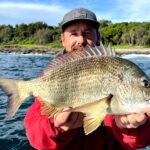
Autumn conditions in Sydney offer some of the most spectacular and productive fishing windows of the year, but they require a vigilant eye on the barometer and wind forecasts. The inner reaches of Botany Bay remain highly fishable and protected, making it a definitive "GO" for small craft, kayak anglers, and land-based fishers. However, extreme caution is absolutely necessary if you are pushing toward the heads near Cape Solander or La Perouse. We are in the transitional season of unpredictable southerly busters and shifting ground swells that can turn the entrance into a highly hazardous zone within an hour. Always check the offshore wave buoy data before venturing past the oil wharf. If the southerly winds exceed 15 knots, tuck into the protected northern shorelines or push up into the lower reaches of the Georges River.
Species Intel
Primary Target: Dusky Flathead
The gradually cooling water has triggered a heavy feeding response from resident Dusky Flathead. They are currently dominating the catch reports, moving from the shallow, sun-warmed flats on the high tide and ambushing baitfish along the primary drop-offs as the water recedes. These ambush predators are feeding heavily to build energy reserves, making them highly aggressive and willing to chase down well-presented lures.
π£Nautrek
Private Beta
J
M
R
100+ anglers on the waitlist
The fishing network where your reputation matters.
Find trusted captains, join real trips with cost splitting, and build your Angler Rank. Your spots stay private — you decide who sees your intel.
While most anglers are chasing the tail end of the summer pelagic run or pounding the flats for Bream, the Silver Trevally bite is quietly firing up. Often dismissed as bycatch, these hard-fighting sportfish are schooling heavily around deep water structures, channel markers, and concrete pylons. They offer fantastic light-tackle action when the primary bite on the flats slows down.
Baitfish & Forage Report
The inshore food web is highly active right now. To consistently catch fish, you need to understand what they are eating. The bay is currently holding a diverse mix of forage:
Yellowtail (Yakkas) and Slimy Mackerel: Schooling heavily around the artificial reefs, channel markers, and the oil wharf. These are the primary protein source for late-season Kingfish and large Mulloway.
Glass Prawns: Abundant in the shallower weed beds and sand flats. When the tide begins to run out, these prawns are forced into the deeper channels, creating a feeding frenzy.
Small Shore Crabs: Clinging to the rocky shorelines and bridge pylons, providing a staple diet for resident Bream and Blue Groper.
Matching this hatch is critical. If you are fishing the deep structure, your presentation must mimic the erratic darting of a baitfish. If you are on the flats, your profile needs to match a fleeing prawn.
Tactical Strategy
Where to Deploy
To find the best Flathead action, head straight to the weed edges around Towra Point Nature Reserve. Do not blind cast the middle of the flats. Instead, position your vessel in 8 to 12 feet of water and cast up onto the 2 to 4-foot sandy patches between the weed beds. Work your lure meticulously down the drop-off. Flathead will sit facing the current, waiting for bait to be swept off the shallow flats into the deeper channels.
For the Silver Trevally, the deep holes and structure around the Sydney Airport Runways and the Captain Cook Bridge pylons are holding dense schools. The key here is water movement. Position yourself up-current and drift your baits back into the strike zone. If the tide goes slack, the Trevally will shut down completely, so plan your assault around the middle two hours of the tidal flow.
Lure Selection
For Flathead, rig up a 3-inch Gulp! Shrimp or a paddle-tail plastic on a 1/4oz jig head. If you are targeting the deeper runway drop-offs for Trevally, switch to a 1/8oz to 1/4oz TT Lures Switchblade metal vibration bait. Keep your presentation close to the bottom.
Color Patterns
Water clarity in the bay is currently excellent. Stick to natural, translucent colors. "Motor Oil" and "Camo" are outperforming everything else in the soft plastic lineup. For the metal blades, golden or pilchard/silver patterns will perfectly mimic the resident baitfish.
Bait & Rigging
If you prefer soaking bait, fresh is non-negotiable. For Flathead, use freshly caught squid cut into long, tapered strips (pennants) fished on a running sinker rig with a 3/0 circle hook. For Bream and Trevally, live nippers or peeled Hawkesbury river prawns fished on a light fluorocarbon leader (6lb to 8lb) with a size 2 long-shank hook will get inhaled instantly.
Pro Tip: When fishing soft plastics for Flathead along the Towra Point weed lines, implement a double-hop retrieve, but ensure your lure maintains contact with the bottom. Most strikes will occur on the pause as the lure kicks up a small puff of sand, mimicking a fleeing prawn.
Prime Timing
The first two hours of the run-in tide coinciding with low light (dawn or dusk) is the golden window. The rising water pushes baitfish out of the deep channels and onto the flats, activating the predatory instincts of both Flathead and Bream.
Pro Tip: Trevally are notoriously line-shy and possess very soft mouths. When you hook up around the bridge pylons, back off your drag slightly. Horsing them away from the structure usually results in a pulled hook. Let a soft-tipped rod absorb their erratic head shakes.
Regulations Snapshot
Before you launch, ensure your NSW Recreational Fishing Fee is paid and the digital or physical receipt is on your person. Botany Bay is heavily patrolled, and ignorance is not an excuse.
Species
Minimum Size Limit
Bag Limit
Special Rules
Dusky Flathead
36 cm
5 per person
Only 1 fish over 70 cm allowed.
Yellowfin Bream
25 cm
10 per person
Measured from snout to tip of tail.
Silver Trevally
30 cm
10 per person
Excellent catch-and-release sportfish.
Mulloway (Jewfish)
70 cm
1 per person
Strictly enforced.
Note: It is strictly prohibited to harvest oysters from Botany Bay and its tributaries. Additionally, avoid casting into the commercial shipping lanes and respect the exclusion zones around the airport runways and the oil wharf.
Regional Alternative: Port Hacking
If a heavy southerly front blows out the main basin of Botany Bay, do not pack up your gear. Drive 20 minutes south to Port Hacking. This winding, drowned river valley offers incredible protection from high winds thanks to its steep, forested shorelines.
The Backup Plan
Launch at the Tonkin Street ramp in Cronulla and head straight for the protected sand flats of Lilli Pilli or Gunnamatta Bay. The target species here will shift slightly toward Sand Whiting and Bream. Downsize your tackle to 4lb fluorocarbon leaders and throw small surface poppers or walk-the-dog style stickbaits over the shallow sand patches during the high tide. If surface action is slow, drifting live bloodworms or yabbies in the channels will keep the rods bending until the weather in Botany Bay settles down.
Pro Tip: When fishing surface lures for Whiting in Port Hacking, never pause the retrieve if a fish swirls and misses. Keep the lure moving at a constant, erratic pace to trigger an aggressive reaction strike.
Tight lines!
Editor's Choice: Must-Have Gear
FISHINGSIR Next-Gen Waterproof Chest Waders
β β β β β 4.4 (7,370+ reviews)
2-Ply Tech: Upgraded nylon with 2.5x higher density than standard fabrics.
100% Waterproof: Lab-approved intrusion resistance with taped visible seams.
Ultra-Lightweight: Designed for all-day comfort while hunting or fishing.
As an Amazon Associate I earn from qualifying purchases. #ad
Loading forecast...
Live Fishing Conditions: Tides, Weather & Waves
Get realβtime tides, marine weather, swell and solunar activity for each spot so you know exactly when conditions line up for your best chance at a bite.
π£
Botany Bay
Loading coordinates...
π€οΈ
WEATHER CONDITIONS
--Β°F
--Β°C
Loading...
π‘οΈ
Feels Like--Β°F--Β°C
π§
Humidity--%
π¨
Wind-- mph-- km/h
π§
Direction--
π
Pressure-- inHg-- hPa
βοΈ
UV Index--
π
MARINE CONDITIONS
πWave Height
-- ft
-- m
Loading...
π§Wave Direction
--Β°
Loading...
β±οΈWave Period
-- s
Loading...
πTide Status
-- ft
-- m
Loading...
π
LUNAR & SOLUNAR
π
Loading...
Illumination: --%
Major Period--:-- - --:----:-- - --:--
Minor Period--:-- - --:----:-- - --:--
π Sunrise--:--
πSunset--:--
π
24-HOUR FORECAST
Loading fishing conditions...
Fishing Spots Map
My location
Loading map...
Unable to load map
There was an error loading the map. Please try refreshing the page.
Info
Local Access & Facilities
Botany Bay represents a strategic intersection of history, industry, and prime angling water on the coast of New South Wales. For the serious angler, this isn't just a bay; it is a complex marine environment where deep shipping channels meet expansive flats and the open ocean swells of the Tasman Sea. The location offers a unique juxtaposition where anglers might cast lines in the shadow of massive container ships or drift along the rugged, natural shorelines of the Kurnell Peninsula. The bay serves as a critical gateway for pelagic species entering from the ocean and holds a reputation for challenging conditions that reward preparation and local knowledge.
The atmosphere here is strictly utilitarian meets natural beauty. While the northern side is dominated by the industrial prowess of the port and the airport, the southern reaches near Kurnell offer a glimpse into the raw, sandstone-lined coast that defines this region of Australia. For captains, the bay provides reliable deep-water access regardless of the tide, a significant advantage over shallower estuary systems nearby. The sheer volume of water moving through the heads creates dynamic current lines that seasoned skippers exploit for drift fishing.
Targeting the fishery requires understanding the logistical layout. The bay is vast, and the distance between the boat ramps and the prime fishing grounds near the heads can be significant. This guide focuses on the practicalities of launching, provisioning, and navigating the local infrastructure to ensure your focus remains on the sounder and the spread, rather than logistical headaches on land.
Access & Getting There
Accessing Botany Bay generally involves navigating the busy corridors of southern Sydney. For anglers towing vessels, the primary approach is typically via the Princes Highway or the M5, funneling traffic toward the coastal suburbs. The proximity to Sydney Airport (Mascot) means that traffic congestion is a constant variable; seasoned locals know to account for "airport traffic" even at early hours. The roads leading into the launch areas are generally wide and well-maintained, suited for heavy trailer loads, but the final approaches to specific ramps can tighten up during weekends.
The primary launch facility identified for serious operations is the Port Botany Boat Ramp. Located approximately 2.5 miles from the central coordinate of the bay, this facility is engineered to handle substantial vessel traffic. Data indicates that this ramp features dedicated trailer parking, a critical necessity for captains running center consoles or larger offshore boats. Unlike smaller, impromptu launches, the Port Botany facility is designed for efficiency, though the sheer popularity of the bay means early arrival is standard operating procedure.
π‘ Captain's Tip: Launch Logistics
While the Port Botany Boat Ramp is the primary hub with trailer parking, always have a backup plan. During peak season, the lot fills rapidly. Ensure your trailer lights and bearings are serviced, as the salt exposure here is high due to the oceanic influence near the heads.
Weather plays a massive role in access strategies here. The bay's orientation leaves it exposed to swells rolling in from the southeast. When the wind opposes the tide, particularly near the entrance, the sea state can deteriorate rapidly into a steep, dangerous chop. It is vital to monitor wind forecasts relative to tidal movements before committing to a crossing. There are additional unnamed boat launch points located 1 mile and 2.3 miles from the center spot, which may offer alternatives depending on wind direction, though their amenities are less documented than the main port ramp.
Parking for non-towing vehicles is abundant but requires selection. Facilities like Park & Fly and Airport Express Car Parking are located roughly 4 miles away in Mascot. While highly rated, these are geared toward air travelers. Anglers meeting a charter or crew members joining a boat should look for parking closer to the specific departure wharf. For shore-based anglers, the data highlights specific shore access points suitable for families, where parking is generally available but unassigned.
Botany Bay Pre-Trip Checklist
Facilities & Amenities
The infrastructure surrounding Botany Bay is robust, supporting both the recreational angler and the professional fleet. The area is serviced by a network of specialized tackle shops that cater to the specific needs of this fishery. Unlike generic sporting goods stores, the local shops here operate on "fisherman's hours," acknowledging that the best bite often happens before the sun clears the horizon.
For the dawn patrol crew, Castwide Fishing Goods in Arncliffe is the logistical MVP, opening its doors at 4:00 AM. Located about 5.4 miles from the water, it is perfectly positioned for grabbing fresh bait and terminal tackle on the drive in. Mac's Bait Bar in Blakehurst (4.8 miles away) is another stalwart institution, opening at 5:00 AM. These shops don't just sell gear; they are information hubs where you can glean the latest reports on water clarity and bait movement.
π‘ Captain's Tip: Bait Shop Strategy
Castwide Fishing Goods opens at 4:00 AM, a full hour earlier than most competitors. If you are planning a first-light assault on the heads, make this your primary stop for ice and bait to beat the rush.
The charter fleet in this region is highly active, reflecting the quality of the local fishery. Southern Sydney Fishing Tours operates out of Sans Souci, just 4.3 miles away, and is a top-rated option for those seeking local expertise. All At Sea Fishing Charters in Cronulla (5.2 miles) offers access from the southern side. For anglers looking to connect with top-tier operators, the presence of these 5-star rated services indicates a healthy, productive fishing zone managed by captains who understand the nuances of the local currents.
Facility Name
Type
Distance
Opening Time
Specialization
Castwide Fishing Goods
Bait & Tackle
5.4 miles
4:00 AM
Early Access / Bait
Mac's Bait Bar
Bait & Tackle
4.8 miles
5:00 AM
Bait / Local Intel
Southern Sydney Fishing Tours
Charter
4.3 miles
7:00 AM
Local Guiding
Port Botany Boat Ramp
Launch
2.5 miles
24 Hours
Trailer Parking
Accommodation options vary depending on the nature of your trip. For those towing boats who need proximity, Bridge Beach in Padstow Heights offers a highly-rated stay roughly 9.8 miles out. For the adventurous or budget-conscious angler, Kingfisher Pool campground in Heathcote (15.8 miles) provides a rustic base camp. Conversely, high-end options like QT Sydney are available in the CBD, but the 8.5-mile logistical trek through city traffic with gear makes this less ideal for early starts.
It is important to note a gap in immediate amenities at the water's edge. While the boat ramp has parking, data indicates that restrooms, showers, and fish cleaning stations are not explicitly confirmed at the ramp site itself in the primary dataset. Anglers should be self-sufficient regarding water, ice, and fish processing, handling these tasks either on the boat or back at home base.
Permits, Regulations & Fees
Navigating the regulatory environment is as crucial as navigating the channels. Fishing in Botany Bay and the surrounding waters falls under the jurisdiction of the State Fishing Agency. While specific permit prices fluctuate, a valid recreational fishing license is mandatory for all anglers. These funds contribute directly to the conservation of the fishery and the maintenance of the very ramps used to access it.
The area is subject to strict zoning, particularly given the heavy industrial traffic and proximity to the airport. Anglers must be vigilant regarding exclusion zones around the runways and shipping terminals. The Port Botany area is a working port; interfering with commercial traffic is not only dangerous but carries heavy fines. Always respect the right-of-way of larger vessels in the channels.
π‘ Captain's Tip: Port Security
Maintain a wide berth around the airport runways and container terminals. Security zones are strictly enforced, and drifting into a restricted area can end your fishing trip immediately. Keep your VHF radio on and monitor local channels.
Shore access points identified in the data are suitable for families, suggesting these areas are likely public reserves. However, respect for the environment is paramount. This region has deep cultural significance, and "Kapu" (restrictions) or general stewardship principles should be observed. Leave no trace, particularly monofilament and bait packaging, to ensure these access points remain open to the public.
Events & Seasonal Information
The rhythms of Botany Bay are dictated by the seasons of the Tasman Sea. The fishery is active year-round, but the strategies shift significantly. The bait shops, such as Flick n Fish and Mac's Bait Bar, maintain long hours (often until 10:00 PM or 11:00 PM), catering to the nocturnal crowd that targets species active after dark. This late-night availability suggests a robust night-fishing culture, likely focusing on the turn of the tide under the cover of darkness.
Tournament anglers should note the caliber of the local charter fleet. Operations like Rising Tide Fishing Charters and Best Sydney Fishing Charters (both located near Rose Bay, roughly 9 miles away) are indicative of a competitive sportfishing scene. While specific tournament dates vary, the presence of these high-end operators suggests that the warmer months likely bring a run of game fish that attracts serious attention from the heavy-tackle community.
Timing your day is critical. With trade winds often picking up by mid-morning, the "dawn patrol" strategy is not just a preference but a necessity for small boat safety. The fact that Castwide Fishing Goods opens at 4:00 AM is a strong indicator that the most productive and safest fishing occurs in the pre-dawn and early morning hours before the sea breeze builds the chop in the bay.
Contact Information & Resources
For emergency situations, safety on the water is the skipper's responsibility. While the bay is enclosed, it is large enough to present real danger. Immediate emergencies should be directed to standard emergency services. For local maritime queries, the State Fishing Agency remains the authority on current rules and closures.
Southern Sydney Fishing Tours: 0418 169 439 (Charter)
All At Sea Fishing Charters: 0455 779 989 (Charter)
Always file a float plan with a contact on land before departing. The industrial nature of the bay means help is often nearby, but self-reliance is key. For precise locations of the boat ramps, real-time wind data, and detailed bathymetry, consult the live dashboard and interactive maps below.
π£
Botany Bay
Kurnell β’ New South Wales β’ -33.9937, 151.2008
Our spot reports combine data-driven forecasts with curated local information. The forecast is generated by our proprietary Fishing Score algorithm (0β100%), which analyzes real-time data from Open-Meteo API, validated against NOAA CO-OPS tide gauges and USGS water-monitoring stations. The model weights tide dynamics (35%), wave energy (25%), wind patterns (20%) and time of day (20%)βfactors shown to influence fish feeding behavior through marine-biology research and decades of charter log data.
Access, facilities and services information for each fishing spot is sourced from official datasets such as Recreation.gov (RIDB), state park & wildlife agencies, and geospatial providers like Google Maps. These sections undergo scheduled re-validation every 3β6 months to ensure that boat ramps, park access, contact details and local services remain accurate.
Narrative sections (catches, seasonal behavior, local tips) are synthesized from these data sources and refined following the Fishing Reports Today editorial guidelines, combining bibliographic research from ichthyology and oceanography with expert angler experience. Our team reviews reports on a regular basis, while the forecast model itself updates every 6 hours for real-time accuracy.
β οΈ Important: Always verify current local regulations, access restrictions and weather conditions before fishing. These reports are intended as a planning aid, not a guarantee of catches or safety. When in doubt, contact local authorities or park managers listed on the page.
To provide the best experiences, we use technologies like cookies to store and/or access device information. Consenting to these technologies will allow us to process data such as browsing behavior or unique IDs on this site. Not consenting or withdrawing consent, may adversely affect certain features and functions.
Functional Always active
The technical storage or access is strictly necessary for the legitimate purpose of enabling the use of a specific service explicitly requested by the subscriber or user, or for the sole purpose of carrying out the transmission of a communication over an electronic communications network.
Preferences
The technical storage or access is necessary for the legitimate purpose of storing preferences that are not requested by the subscriber or user.
Statistics
The technical storage or access that is used exclusively for statistical purposes.The technical storage or access that is used exclusively for anonymous statistical purposes. Without a subpoena, voluntary compliance on the part of your Internet Service Provider, or additional records from a third party, information stored or retrieved for this purpose alone cannot usually be used to identify you.
Marketing
The technical storage or access is required to create user profiles to send advertising, or to track the user on a website or across several websites for similar marketing purposes.
Leave a Reply