Central Coast Winter Fishing Report: Brisbane Water & Tuggerah Lakes
1. GO/NO-GO STATUS
Verdict: GO β with tactical adjustments for winter conditions.
Winter on the Central Coast of New South Wales brings crisp mornings and clear skies, making for excellent, albeit chilly, fishing conditions. Early morning air temperatures can dip near freezing (around 6°C to 8°C), often bringing a thick layer of fog to the river valleys and estuaries. The primary weather factor to monitor before launching is the prevailing westerly wind. When the westerlies blow hard, the shallow, open expanses of Tuggerah Lakes can become heavily chopped up and unfishable. However, the deeply sheltered bays of Brisbane Water offer excellent protection from these gusts.
Dress in warm, moisture-wicking layers, prepare for frosty boat decks at dawn, and focus your efforts around the tide changes. There are no ice conditions to worry about in this region, but the water temperatures have steadily dropped to around 16°C to 17°C. This cooler water dictates a much slower, more methodical approach to your retrieves. If you plan your trips around the wind and the afternoon sun, you will find plenty of active fish.
π£Nautrek
Private Beta
J
M
R
100+ anglers on the waitlist
The fishing network where your reputation matters.
Find trusted captains, join real trips with cost splitting, and build your Angler Rank. Your spots stay private — you decide who sees your intel.
Primary Target: Luderick (Blackfish) and Yellowfin Bream
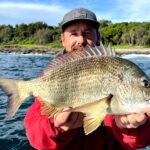
As the estuary waters cool, Luderick become the undisputed champions of the Central Coast. They are schooling up heavily around established weed beds, rocky points, and oyster leases, feeding actively throughout the day. Yellowfin Bream are also highly aggressive right now, taking advantage of the clearer winter water to feed heavily before their spawning cycle.
Most anglers abandon Flathead tactics when the water temperature drops below 18°C, assuming the fish have completely shut down. While their metabolism certainly slows, big "croc" Flathead are still highly catchable if you adjust your depth. Instead of the shallow summer sand flats, these fish retreat to the 6 to 8-metre drop-offs and deeper holes where water temperatures remain slightly more stable. Additionally, winter is prime time for school-sized Mulloway around structure, particularly during the tide changes at night.
Baitfish Report:
The annual mullet run has largely concluded, meaning the massive schools of larger forage have moved out to sea. The estuaries are currently holding smaller baitfish, glassies, and juvenile prawns. You will also encounter roaming schools of juvenile Tailor. Downsize your lure profiles to match this smaller winter hatch, and be prepared for the occasional bite-off from the toothy Tailor.
3. TACTICAL STRATEGY
To succeed in these cooler conditions, you need to be highly specific with your locations and presentations. A run-and-gun approach rarely works in winter; patience and precision are key.
Where to Fish
Focus your primary efforts on Brisbane Water. For Luderick, position your boat, kayak, or fish land-based adjacent to the oyster leases on the northern side of Pelican Island. The shorelines around Saratoga and Davistown, where green weed grows naturally on the submerged rocks, are also holding fantastic numbers of fish.
For winter Flathead, use your sounder to locate the 6 to 8-metre channel edges between Fisherman's Wharf and Lions Park in Woy Woy. Look for the distinct current lines where dirty water meets clean water on a tidal push; predator fish will sit on the bottom and ambush bait along this seam. If you are targeting Mulloway, focus on the deeper holes around The Rip Bridge during the slack water of a tide change.
Lure Selection & Color
Flathead & Bream: Downsize your fluorocarbon leader to 8lb to compensate for the gin-clear winter water. Use a 1/8oz or 1/6oz tungsten jighead paired with a 2.5-inch to 3-inch curl-tail soft plastic (such as a ZMan GrubZ or Squidgies Wriggler).
Color: "Motor Oil" or natural translucent baitfish profiles are vastly outperforming bright, solid colors right now. Profile size is far more critical than colorβkeep it compact.
Blades & Vibes: Small metal vibes (like the Ecogear ZX40) are excellent for working the deeper holes. They send out strong vibrations that can wake up a lethargic winter Flathead or Bream.
Bait Recommendations
For Luderick, fresh green cabbage weed or string weed is absolutely essential. Suspend it 2 to 3 feet below a sensitive stem float. For Bream, live pink nippers (pumped from the local sandflats at low tide) or fresh squirt worms fished on a very light running sinker rig will rarely be refused. If targeting Mulloway, fresh squid strips or live yellowtail (yakkas) are the baits of choice.
Pro Tip:When setting up your Luderick float, use just enough split shot on your leader to cock the float so that only the very tip is visible above the surface. Winter Luderick can be incredibly finicky, and if they feel the buoyancy resistance of a poorly weighted float, they will spit the weed instantly.
Timing the Bite
Timing is everything when the water is cold. For Flathead, skip the freezing dawn patrol entirely. The best bite consistently occurs in the mid-to-late afternoon on a run-in tide. The sun has had several hours to warm the shallow adjacent flats, pushing slightly warmer water into the drop-offs and triggering a feeding window. For Luderick, the first two hours of the run-in tide in the early morning or late afternoon remain the prime windows.
Pro Tip:When fishing soft plastics or blades for winter Flathead, slow your retrieve down by at least 50%. A lethargic winter fish will not expend the energy to chase a fast-moving bait. Incorporate long pauses, letting your lure sit completely motionless on the bottom for up to 5 seconds before giving it the next subtle twitch.
4. REGULATIONS SNAPSHOT
Ensure you are up to date with the latest New South Wales Department of Primary Industries (DPI) regulations before hitting the water. Fines for undersized fish are steep. Here is a quick reference guide for our primary winter targets:
Species
Minimum Legal Length
Bag Limit / Special Rules
Luderick (Blackfish)
27 cm
10 per person (Possession limit 20)
Yellowfin Bream
25 cm
10 per person (Combined limit with Tarwhine)
Dusky Flathead
36 cm
10 per person (Only 1 fish allowed over 70 cm)
Tailor
30 cm
10 per person
Mulloway (Jewfish)
70 cm
1 per person
Conservation Note: Always handle large breeding female Flathead (those over 70cm) with wet hands, support their belly horizontally, and release them quickly to ensure the future health of the estuary fishery.
5. REGIONAL ALTERNATIVE: TUGGERAH LAKES ENTRANCE
If Brisbane Water is too crowded, or if the westerlies are making boat positioning impossible in the open bays, your absolute best fallback option is The Entrance at Tuggerah Lakes. While the main body of Tuggerah Lake can be painfully slow and hazardous for small boats during winter winds, the channel at The Entrance acts as a natural, protected funnel.
The Approach: Park near the boardwalk on the western side of the bridge. This land-based spot is highly accessible, family-friendly, and offers great protection from westerly gusts. Fish the last two hours of the run-out tide as the water is pushed forcefully through the narrow channel. Cast lightly weighted baits (such as unweighted peeled prawns or whitebait) up-current and let them drift naturally along the bottom, sweeping past the bridge pylons.
This is a highly effective, low-effort tactic for intercepting Bream and Flathead that are waiting in the eddies to ambush bait flushed out from the main lake system. You can also cast small surface poppers or shallow-running hardbodies along the boardwalk edges at first light to trigger aggressive strikes from Bream.
Pro Tip:If you are fishing the boardwalk at The Entrance, always bring a long-handled landing net. The drop from the boardwalk to the water can make lifting a legal-sized fish difficult, and trying to dead-lift them up by the line often results in pulled hooks and lost catches right at your feet.
Tight lines!
Editor's Choice: Must-Have Gear
FISHINGSIR Next-Gen Waterproof Chest Waders
β β β β β 4.4 (7,370+ reviews)
2-Ply Tech: Upgraded nylon with 2.5x higher density than standard fabrics.
100% Waterproof: Lab-approved intrusion resistance with taped visible seams.
Ultra-Lightweight: Designed for all-day comfort while hunting or fishing.
As an Amazon Associate I earn from qualifying purchases. #ad
Loading forecast...
Live Fishing Conditions: Tides, Weather & Waves
Get realβtime tides, marine weather, swell and solunar activity for each spot so you know exactly when conditions line up for your best chance at a bite.
π£
Central Coast
Loading coordinates...
π€οΈ
WEATHER CONDITIONS
--Β°F
--Β°C
Loading...
π‘οΈ
Feels Like--Β°F--Β°C
π§
Humidity--%
π¨
Wind-- mph-- km/h
π§
Direction--
π
Pressure-- inHg-- hPa
βοΈ
UV Index--
π
MARINE CONDITIONS
πWave Height
-- ft
-- m
Loading...
π§Wave Direction
--Β°
Loading...
β±οΈWave Period
-- s
Loading...
πTide Status
-- ft
-- m
Loading...
π
LUNAR & SOLUNAR
π
Loading...
Illumination: --%
Major Period--:-- - --:----:-- - --:--
Minor Period--:-- - --:----:-- - --:--
π Sunrise--:--
πSunset--:--
π
24-HOUR FORECAST
Loading fishing conditions...
Fishing Spots Map
My location
Loading map...
Unable to load map
There was an error loading the map. Please try refreshing the page.
Info
Local Access & Facilities
The Central Coast of New South Wales represents a dynamic intersection of estuarine complexity and nearshore potential, offering a diverse playground for the serious angler. Situated between the bustling metropolis of Sydney and the industrial hub of Newcastle, this regionβspecifically around the Palm Grove and Gosford corridorβprovides a strategic staging ground for accessing the expansive Brisbane Water and the Hawkesbury River systems. The topography here shifts dramatically from the dense, gum-tree lined ridges of the hinterland to the intricate waterways that carve through the sandstone geology, creating a fishery that demands versatility from its captains. Whether you are targeting bream in the structure-laden creeks or heading out for coastal pelagics, the local atmosphere is one of deceptive tranquility that masks a highly active marine ecosystem.
For the traveling angler or the seasoned local looking to refine their logistics, the area around Palm Grove serves as a central hub, though it requires a tactical approach to navigation and timing. The vibe here is distinctly Australian coastalβlaid back but serious about its water sports. Unlike the manicured, concrete-heavy harbors of major cities, the access points here often blend seamlessly with the natural bushland, requiring a heightened level of awareness regarding tides and trailer management. The primary game here is often dictated by the estuarine flows, where the tidal exchange between the ocean and the expansive interior lakes drives the feeding windows.
Understanding the logistical layout is paramount for a successful expedition in this region. The distance between your accommodation in the hinterland and the salt water requires careful planning, particularly regarding bait acquisition and boat launching. This is not a "walk to the dock" fishery; it is a destination that favors the mobile angler equipped with a reliable vehicle and a well-maintained trailer. The following guide breaks down the essential infrastructure, from the most reliable boat ramps to the tackle shops that open early enough to support a true dawn patrol.
Access & Getting There
Navigating to the prime fishing grounds from Palm Grove involves traversing a mix of arterial roads and local thoroughfares that can be deceptive in their travel times. The primary access corridor often involves utilizing the Pacific Highway or the M1, depending on your approach direction. While the distance to the water may seem short on a map, the winding nature of the coastal roads means you should budget extra time, particularly during the morning rush or weekend holiday traffic. Experienced skippers know that the "short cut" through the back roads can often lead to delays when towing a wide-beam vessel, so sticking to the main haulage routes toward Gosford is generally the prudent choice.
The centerpiece of the boating logistics in this zone is the Gosford City Park Dane Drv Boat Ramp. Located approximately 8.4 miles from the central reference point, this facility is the primary launch candidate for accessing the broader waterway. The ramp is situated along Dane Drive, offering direct access to the northern reaches of Brisbane Water. While the ramp is paved and features trailer parking, captains should be acutely aware of the specific amenitiesβor lack thereof. Data indicates that while parking is available, the site does not feature on-site restrooms, showers, or fish cleaning stations. This means all boat preparation and biological waste management must be handled off-site or with onboard systems. You must arrive fully self-contained.
π‘ Captain's Tip: Ramp Readiness
Since the Gosford City Park ramp lacks wash-down and cleaning facilities, seasoned pros bring a 5-gallon jerry can of freshwater to rinse trailer brakes immediately after retrieval, rather than waiting until they get home.
For those looking to wet a line without a vessel, the Banksia Picnic Area offers a viable shore access point roughly 4.3 miles away. This location is particularly suitable for family outings or light tackle estuary reconnaissance. The terrain here allows for bank fishing, but as with all shore entry points in this region, footwear is non-negotiable due to the potential for sharp oysters and uneven sandstone ledges. There is also a secondary, unnamed shore access point nearby that is suitable for shore casting; however, parking notes are sparse, suggesting this is a drop-off zone or requires finding street parking further afield.
Parking for trailers is a critical consideration. While the Gosford City Park ramp has designated trailer spots, overflow parking in the region can be tricky. The Stoney Creek Car Park, located 4.8 miles away, is a highly-rated parking area, but it is essential to verify if it can accommodate a boat trailer before committing to it as a staging area. Avoid generic commercial lots like the loading docks listed in general databases; stick to the designated recreational parking areas to avoid fines or tow-aways. Security is generally good in these high-visibility areas, but the standard rule applies: never leave high-value electronics or tackle visible in the truck bed.
Central Coast Pre-Trip Checklist
Facilities & Amenities
The quality of your fishing trip often hinges on the quality of your support network on land. In this region, the bait and tackle landscape is robust, but the shops are spread out, requiring you to choose your provider based on your route to the ramp. West Gosford Bait & Tackle is the closest dedicated outfitter, located 7.2 miles from the center. Rated exceptionally high by locals, this shop is the logical pitstop for those launching at Gosford. However, for the serious angler planning a pre-dawn assault, checking operating hours is vital.
For those heading out on a Saturday morning mission, Empire Fishing and Boating in Woy Woy (12.5 miles away) is a strategic asset. With opening hours starting at 6:00 AM on Saturdays, it is one of the few shops that accommodates the early riser looking to beat the sunrise. They are open seven days a week, making them a reliable backup if you break a guide or run out of leader material on a Sunday. Hot Tackle Morisset, although further out at 16.3 miles, maintains a stellar reputation and opens at 7:00 AM on weekends. This shop is likely the better option if you are approaching the region from the north.
π‘ Captain's Tip: The Sunday Gap
Note that West Gosford Bait & Tackle and Seacoast Fishing are listed as closed on Sundays. If you are planning a weekend trip, buy your frozen bait and terminal tackle on Saturday or route your drive through Woy Woy to hit Empire Fishing.
The following table outlines the key logistical details for local provisioning:
Establishment
Distance
Specialization & Notes
West Gosford Bait & Tackle
7.2 miles
Closest to main ramp; closed Sun/Mon/Tue/Wed (Check hours carefully).
Empire Fishing and Boating
12.5 miles
Opens 6 AM Sat; Reliable 7-day operation; Woy Woy location.
Seacoast Fishing
12.4 miles
Kincumber location; Closed Sun-Wed; Good for mid-week afternoon prep.
Hot Tackle Morisset
16.3 miles
High rating (4.9); Opens 7 AM weekends; Northern approach option.
Regarding charter operations, the region supports a fleet of knowledgeable captains who specialize in the local waterways. Hawkesbury Fishing Charters, based in Davistown (12.5 miles away), offers access to the legendary Hawkesbury River system, known for its mulloway and kingfish. Hardys Bay Charters operates out of Killcare (14.9 miles away) and provides another excellent gateway to the broken bay and offshore grounds. These operators are essential resources for transient anglers who want to learn the specific seasonal patterns before taking their own vessels out.
Accommodation in the area ranges from rustic to refined. For the angler who wants to be close to nature, Elebanah Luxury Camping in Avoca Beach offers a unique stay 12.9 miles from the spot. On the higher end, Bells at Killcare Boutique Hotel provides luxury amenities roughly 14.9 miles away, perfect for a trip that balances hard fishing with relaxation. For a standard stay, Tiarri Terrigal is a solid option. When booking, always verify trailer parking availability with the host, as many boutique locations may not have the turning radius required for a 20-foot boat.
Permits, Regulations & Fees
Fishing in New South Wales is a regulated activity managed by the State Fishing Agency. The primary requirement for all recreational anglers is the payment of the NSW Recreational Fishing Fee. This applies to spearfishers, hand liners, hand gatherers, trap setters, and bait collectors. It is imperative to carry your receipt or digital license at all times, as fisheries officers frequent the boat ramps at Gosford and the shore access points at Banksia.
The regulations here are in place to ensure the sustainability of the fishery, particularly for slow-growing estuarine species. Bag and size limits are strictly enforced. While the specific data for this location does not indicate unique "permit required" zones beyond the standard state license, anglers should always be vigilant for local signage. Protected areas, such as marine sanctuaries or specific "Kapu" (restricted) zones related to cultural heritage or conservation, may exist within the broader waterway system. Ignorance of these zones is not a valid defense.
There are no specific launch fees listed for the Gosford City Park ramp in the provided data, which is a significant advantage for the frequent angler. However, "free" access often correlates with high traffic. The cultural etiquette here dictates efficiency on the ramp. Prepare your vessel in the parking lotβstraps off, bungs in, battery onβbefore approaching the water. Blocking the ramp while you load gear is a major faux pas that will quickly alienate you from the local fleet.
Events & Seasonal Information
The rhythm of the Central Coast fishery is dictated by the seasons and the winds. While specific tournament dates are not provided in the current data, the presence of high-caliber tackle shops like Hot Tackle and Empire Fishing suggests a community that is active year-round. Generally, the warmer months bring increased activity in the estuaries and a push of warm water currents offshore that attract pelagic species. Conversely, the cooler months often see a shift toward targeting resident species in the deeper holes of the river systems.
Timing your day is critical. The wind patterns in this coastal region often follow a diurnal cycle, with calm conditions in the early morning giving way to sea breezes in the afternoon. With shops like Empire Fishing and Boating opening at 6:00 AM on Saturdays, the "dawn patrol" strategy is clearly the local standard. Launching early not only beats the wind but also secures you a parking spot at the popular Gosford City Park ramp before the recreational crowd arrives.
π‘ Captain's Tip: Wind Windows
The distance between the ramp and the open ocean or lower estuary can be significant. Always check the midday wind forecast. If the sea breeze is predicted to kick up over 15 knots, plan your return trip to the ramp before noon to avoid a pounding ride home against the chop.
Contact Information & Resources
For emergency situations, safety is the responsibility of the skipper. The local waterways are patrolled, but response times can vary. Ensure your marine radio is functional and tuned to the local repeater channels. For specific inquiries regarding ramp conditions or local maritime rules, contacting the local council or the State Fishing Agency is recommended. While no specific harbor master phone number is listed for the Gosford ramp, local tackle shops like West Gosford Bait & Tackle (Phone: (02) 4324 6522) are often the best source of real-time intelligence regarding water clarity, debris hazards, and recent bite patterns.
Always prioritize safety notes: check weather and ocean conditions before fishing, and wear appropriate footwear and sun protection. The Australian sun is unforgiving, and the UV index can be extreme even on cloudy days. For precise locations, real-time weather overlays, and detailed navigation markers, consult the live dashboard and interactive maps located below.
π£
Central Coast
Palm Grove β’ New South Wales β’ -33.3117, 151.3121
Our spot reports combine data-driven forecasts with curated local information. The forecast is generated by our proprietary Fishing Score algorithm (0β100%), which analyzes real-time data from Open-Meteo API, validated against NOAA CO-OPS tide gauges and USGS water-monitoring stations. The model weights tide dynamics (35%), wave energy (25%), wind patterns (20%) and time of day (20%)βfactors shown to influence fish feeding behavior through marine-biology research and decades of charter log data.
Access, facilities and services information for each fishing spot is sourced from official datasets such as Recreation.gov (RIDB), state park & wildlife agencies, and geospatial providers like Google Maps. These sections undergo scheduled re-validation every 3β6 months to ensure that boat ramps, park access, contact details and local services remain accurate.
Narrative sections (catches, seasonal behavior, local tips) are synthesized from these data sources and refined following the Fishing Reports Today editorial guidelines, combining bibliographic research from ichthyology and oceanography with expert angler experience. Our team reviews reports on a regular basis, while the forecast model itself updates every 6 hours for real-time accuracy.
β οΈ Important: Always verify current local regulations, access restrictions and weather conditions before fishing. These reports are intended as a planning aid, not a guarantee of catches or safety. When in doubt, contact local authorities or park managers listed on the page.
To provide the best experiences, we use technologies like cookies to store and/or access device information. Consenting to these technologies will allow us to process data such as browsing behavior or unique IDs on this site. Not consenting or withdrawing consent, may adversely affect certain features and functions.
Functional Always active
The technical storage or access is strictly necessary for the legitimate purpose of enabling the use of a specific service explicitly requested by the subscriber or user, or for the sole purpose of carrying out the transmission of a communication over an electronic communications network.
Preferences
The technical storage or access is necessary for the legitimate purpose of storing preferences that are not requested by the subscriber or user.
Statistics
The technical storage or access that is used exclusively for statistical purposes.The technical storage or access that is used exclusively for anonymous statistical purposes. Without a subpoena, voluntary compliance on the part of your Internet Service Provider, or additional records from a third party, information stored or retrieved for this purpose alone cannot usually be used to identify you.
Marketing
The technical storage or access is required to create user profiles to send advertising, or to track the user on a website or across several websites for similar marketing purposes.
Leave a Reply