Winter fishing across the Bellarine Peninsula and the southern reaches of Port Phillip Bay is currently in full swing, but it demands absolute respect for the elements. While ice is obviously not a factor in these temperate Australian waters, the Southern Ocean cold fronts and heavy ground swells pushing through Port Phillip Heads (The Rip) are the primary safety concerns. When strong southerly or south-westerly winds collide with a roaring outgoing tide, the pressure waves and standing swells in the main channels become incredibly dangerous for small craft.
However, the beauty of Queenscliff is its proximity to highly protected waters. If the open bay is blown out, sheltered zones like Swan Bay and the Queenscliff Harbour offer safe, highly productive fishing. Always check the local marine forecast and tidal streams before launching. If the wind opposes the tide in The Rip, stay inshore. For land-based anglers, the local piers offer safe and productive platforms regardless of most offshore conditions.
π£Nautrek
Private Beta
J
M
R
100+ anglers on the waitlist
The fishing network where your reputation matters.
Find trusted captains, join real trips with cost splitting, and build your Angler Rank. Your spots stay private — you decide who sees your intel.
The winter transition has pushed the summer pelagics out into the Bass Strait, replacing them with some of the most sought-after table fish in Victoria.
Primary Target: King George Whiting and Southern Calamari. Winter is the premier season for targeting large, thick-shouldered whiting and massive calamari that aggregate over the dense seagrass beds to feed and spawn.
Sleeper Pick: Gummy Shark. Many casual anglers pack away their heavy gear during the colder months, completely missing out on the exceptional winter gummy shark fishery. These localized sharks cruise the deep channel drop-offs and the edges of the Nepean Bay Bar, feeding aggressively on passing forage.
Baitfish Report: The inshore zones are currently holding excellent numbers of bass yabbies, pipis on the beaches, and small schooling baitfish like blue mackerel. Schools of Australian Salmon are also pushing through the heads, providing both excellent light-tackle sport and premium fresh bait for larger predators.
3. TACTICAL STRATEGY
Success in this region relies heavily on understanding the complex bathymetry and tidal movements. The underwater topography near Queenscliff is defined by the Nepean Bay Bar, a massive network of shallow sand shoals that sharply drop into main shipping channels reaching depths of over 20 meters. This dramatic structural change creates powerful tidal upwellings that disorient baitfish, making the transition zones between the deep channels and the shallow seagrass beds the ultimate ambush points. Here is the specific breakdown for targeting our primary winter species.
King George Whiting & Southern Calamari
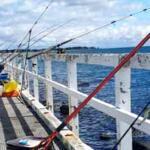
Where: For boat-based anglers, focus your efforts on the 3 to 6-meter depth contours where clean sand holes intersect with heavy seagrass beds. The Lonsdale Bight and the sheltered waters of Swan Bay are prime holding zones. Position your vessel on the up-current edge of a sand hole so your baits drift back naturally into the clearing. For land-based anglers, the Queenscliff Pier (located at the end of Symonds Street) is producing excellent calamari catches, particularly around the lower landing and the pylons during the incoming tide.
Lure: When targeting calamari, utilize size 3.0 to 3.5 squid jigs. The sink rate is critical; you want the jig to hover just above the weed canopy without snagging the bottom structure.
Color: Water clarity dictates your jig color. In overcast winter conditions or when the water is slightly off-color from recent rains, UV White, glow-in-the-dark, and solid pink patterns are highly effective. On bright, clear days with high water visibility, switch to natural pilchard or grass whiting patterns.
Bait: For King George Whiting, fresh bait is non-negotiable. Use fresh pipis, bass yabbies, or small, tenderized strips of fresh squid. Rig these on a light paternoster rig with size 6 long-shank hooks. A small piece of red tubing positioned just above the hook acts as an excellent visual attractant.
Timing: The ultimate bite window for Whiting occurs during the two hours immediately following a high tide as the water begins to run out. Calamari are heavily visually oriented and are most active during the high tide change when the water is at its clearest and the current slacks off.
Gummy Shark (The Sleeper Pick)
Where: Sound out the steep 15 to 20-meter drop-offs along the main shipping channels heading towards Mud Islands, or the deep gutters adjacent to the Nepean Bay Bar. Look for undulating bottom structure where sharks can ambush prey out of the main tidal flow.
Bait: Fresh chunks or fillets of Australian Salmon are unmatched for winter gummies. Rig them on a 6/0 to 8/0 circle hook using a heavy running sinker rig.
Timing: Fish the tide changes. The hour before and after the tide change is when the current is manageable enough to keep your baits pinned to the bottom, which is exactly when gummy sharks go on the prowl.
Pro Tip: When fishing for King George Whiting, avoid heavy burley trails which can quickly attract unwanted pest species like toadfish or undersized pinkie snapper. Instead, use a very light, continuous trail of crushed pilchards or specialized whiting pellets. If the bite slows down, do not sit and wait—lift your anchor and move 50 meters to the next sand hole. Whiting are highly mobile foragers.
Pro Tip: When targeting Gummy Sharks in the deep channels, ensure your sinker is heavy enough to hold the bottom against the strong tidal currents of Port Phillip Bay. A bait that spins in the current or lifts off the bottom will be completely ignored by cruising sharks. Use heavy E-Z slide clips and bomb sinkers if necessary.
Pro Tip: When fishing land-based for calamari off the Queenscliff Pier, coat your squid jigs in a specialized UV scent paste. In the cold winter waters, the added olfactory trigger can turn cautious follows into aggressive strikes, especially when the squid are acting timid around the heavy wooden pylons.
4. REGULATIONS SNAPSHOT
Staying compliant with Victorian Fisheries Authority regulations is critical. Here is what you need to know for your primary targets:
King George Whiting: The minimum legal size is 27cm. The bag limit is 20 fish per person.
Southern Calamari: There is no minimum legal size for calamari, but a bag limit of 10 per person applies.
Gummy Shark: The minimum legal size is 45cm (measured from the rear gill slit to the base of the tail). The bag limit is 2 per person.
Regulatory Reminder: Always keep your catch whole or in carcass form while on Victorian waters. You must not fillet your fish until you have completely left the water or are utilizing a designated boat ramp cleaning table. This ensures fisheries officers can accurately measure your catch if inspected.
5. REGIONAL ALTERNATIVE
If the wind is howling from the south or southwest, rendering The Rip and the open waters of Queenscliff unsafe or unfishable, do not cancel your trip. Head north to Corio Bay (Geelong Outer Harbour) or the eastern side of the Bellarine Peninsula at St Leonards.
Corio Bay offers heavily sheltered waters that are protected from southerly blows. Launch at Limeburners Point and work the 4 to 8-meter marks with soft plastics or fresh bait for winter flathead, pinkie snapper, and resident whiting. Alternatively, the St Leonards pier and its surrounding offshore weed beds provide fantastic, protected action for King George Whiting and squid. The bathymetry here is much gentler, and you can comfortably fish the 4-meter weed lines without battling the intense open-ocean swells of Port Phillip Heads.
Tight lines!
Editor's Choice: Must-Have Gear
FISHINGSIR Next-Gen Waterproof Chest Waders
β β β β β 4.4 (7,370+ reviews)
2-Ply Tech: Upgraded nylon with 2.5x higher density than standard fabrics.
100% Waterproof: Lab-approved intrusion resistance with taped visible seams.
Ultra-Lightweight: Designed for all-day comfort while hunting or fishing.
As an Amazon Associate I earn from qualifying purchases. #ad
Loading forecast...
Live Fishing Conditions: Tides, Weather & Waves
Get realβtime tides, marine weather, swell and solunar activity for each spot so you know exactly when conditions line up for your best chance at a bite.
π£
Queenscliff, Bellarine Peninsula
Loading coordinates...
π€οΈ
WEATHER CONDITIONS
--Β°F
--Β°C
Loading...
π‘οΈ
Feels Like--Β°F--Β°C
π§
Humidity--%
π¨
Wind-- mph-- km/h
π§
Direction--
π
Pressure-- inHg-- hPa
βοΈ
UV Index--
π
MARINE CONDITIONS
πWave Height
-- ft
-- m
Loading...
π§Wave Direction
--Β°
Loading...
β±οΈWave Period
-- s
Loading...
πTide Status
-- ft
-- m
Loading...
π
LUNAR & SOLUNAR
π
Loading...
Illumination: --%
Major Period--:-- - --:----:-- - --:--
Minor Period--:-- - --:----:-- - --:--
π Sunrise--:--
πSunset--:--
π
24-HOUR FORECAST
Loading fishing conditions...
Fishing Spots Map
My location
Loading map...
Unable to load map
There was an error loading the map. Please try refreshing the page.
Info
Local Access & Facilities
The Gateway to Port Phillip Bay and Bass Strait
Queenscliff serves as the strategic maritime heart of the Bellarine Peninsula, offering anglers immediate access to one of Australia's most dynamic waterways. Situated at the very mouth of Port Phillip Bay, this fishery is characterized by its proximity to "The Rip," a notorious entrance where tidal flows clash with Bass Strait swells, creating nutrient-rich feeding grounds for pelagic and reef species. Experienced skippers favor this location for its versatility; you can target King George Whiting and Calamari inside the harbor on rough days or punch out into the Strait for serious sport fishing when the weather holds.
The atmosphere here is distinctly nautical, blending historic maritime architecture with a working harbor vibe that caters heavily to the commercial and recreational fleet. Unlike the manicured resort docks found elsewhere, Queenscliff is a functional launchpad for serious fishing, featuring deep water access and rugged coastal geography. The primary draw for expert anglers here includes the seasonal runs of Snapper, the legendary Yellowtail Kingfish battles near the heads, and the year-round pursuit of premium table fish along the weed beds.
π‘ Captain's Tip: Watch the Tide
The tidal exchange at the bay entrance is immense. Experienced locals know that fishing the slack tide is often critical for bottom fishing near the heads, as the current can make holding bottom impossible with standard lead during peak flow.
Access & Getting There
Reaching the Queenscliff fishery is generally a straightforward drive via the Bellarine Highway, though traffic can thicken during peak summer weekends and holiday periods. For those towing heavy rigs, the route is trailer-friendly, but navigators should remain alert for pedestrians and narrow streets once entering the historic township. The primary launch facility is the Queenscliff Boat Ramp, located directly adjacent to the ferry terminal, positioning you less than a mile from the open ocean.
The boat ramp setup is robust, designed to handle the heavy traffic of the bay, featuring trailer parking and a paved surface. According to local access data, the ramp area includes dedicated trailer parking, which is a critical asset given the popularity of this spot. However, the facility's proximity to the bay entrance means it is exposed to specific wind directions; strong easterlies can make launching and retrieving challenging, so having a competent deckhand to manage lines is advisable.
Wheelchair accessibility is rated as "yes" for this location, making it one of the more inclusive access points on the peninsula. While the data indicates no specific permit fees are currently required for the ramp, seasoned travelers know that regulations can shift; always scan the signage at the entry for the most current parking rules. The ramp is your immediate gateway, but be aware that shore access points are also available nearby for family-friendly sessions when the boat stays dry.
π‘ Captain's Tip: Dawn Patrol Logistics
Parking at the Queenscliff ramp is a premium commodity. During the Snapper run, the trailer lot can reach capacity well before sunrise. Plan to arrive by 4:30 AM to secure a spot and prep your vessel without the pressure of a waiting line.
The infrastructure in Queenscliff is tailored to the needs of the independent angler, with a focus on utility over luxury. A standout feature for the early riser is Burnside Country Furniture, Bait and Tackle. Located just 1,400 feet from the water, this shop is the logistical hub for the fleet, opening as early as 6:30 AM on Saturdays and 7:00 AM on Fridays. Unlike generic big-box stores, this proximity allows for last-minute bait acquisitionβfresh squid or pilchardsβright before you hit the ramp.
For more extensive outfitting or specialized gear repairs, you may need to travel slightly inland. Taco Tackle is located approximately 7 miles away in Ocean Grove, and Drysdale Bait & Tackle is roughly 8 miles out, offering reliable alternatives if the local inventory runs low. Accommodations for visiting crews are solid, with the BIG4 Bellarine Holiday Park (5.9 miles) and Riverside Caravan Park (8.4 miles) providing suitable space for vehicles and trailers, ensuring your vessel is secure overnight.
It is important to note the geography regarding listed charters. The data highlights operators like Sorrento Fishing Charters and Bass Strait Charters, which are physically close (approx. 6.4 miles) but located across the bay entrance. For an angler launching at Queenscliff, these are accessible by boat across the water, but require a ferry ride or a long drive around the bay to reach by car. Focus your immediate logistical planning on the Queenscliff side unless you intend to cross the "Rip."
Facility Name
Type
Distance from Ramp
Key Notes
Burnside Bait & Tackle
Supplies
0.26 miles
Opens 6:30 AM Sat; Closest to ramp.
Queenscliff Boat Ramp
Launch
On-site
Trailer parking available; Paved.
Taco Tackle
Supplies
7.0 miles
Open 9 AM - 5 PM; Ocean Grove.
BIG4 Bellarine Park
Lodging
5.9 miles
Trailer-friendly accommodation.
π‘ Captain's Tip: Fuel Management
While bait is close, on-water fuel options can be limited depending on the hour. Smart skippers top off their tanks at highway stations in Ocean Grove or Geelong before entering the Queenscliff bottleneck to avoid premium dockside prices or closed pumps.
Permits, Regulations & Fees
Fishing in this region is managed by the State Fishing Agency (Victorian Fisheries Authority), and strict adherence to regulations is not just legal prudence but a conservation necessity. The unique biodiversity of Port Phillip Bay and the Bass Strait entrance is protected by rigorous size and bag limits, particularly for slow-growing species like Snapper and King George Whiting. Rangers frequent the boat ramps, especially during peak season, so ensure your license is current and digital or physical copies are on hand.
While the provided access data indicates that the boat ramp fees are currently listed as "not required," this is an anomaly for such a high-quality facility in Victoria. Anglers should be prepared for potential parking meters or changes in management; always carry a credit card or coins for parking machines just in case. Ignorance of local parking ordinances is a quick way to ruin a successful trip with a fine on your windshield.
Cultural respect is also paramount. The Bellarine Peninsula holds significance for the Wadawurrung people. Anglers are encouraged to treat the coastline, particularly the rocky outcrops and dune systems, with care. Avoid trampling vegetation when accessing shore spots and ensure all trash, especially fishing line and bait bags, is packed out to protect the marine environment and maintain access for future generations.
Events & Seasonal Information
The fishing calendar in Queenscliff is dictated by the temperature and the migration of pelagics. The warmer months, typically November through April, see the highest traffic as the Snapper enter the bay and Kingfish patrol the heads. This is tournament season, and the ramp can become a hive of activity with competitive anglers vying for the best launch times. During these windows, patience at the ramp is as essential as the right bait.
Winter brings a different rhythm. The crowds thin out, leaving the water to the dedicated locals targeting Calamari and winter Whiting. The swells from the Bass Strait can be more punishing during these months, making the "Rip" unpassable at times. The best fishing windows often revolve around the tide changes; slack water is the golden hour here, regardless of the season, allowing baits to present naturally without being swept away by the fierce currents.
Contact Information & Resources
For emergency assistance or current maritime safety information, relying on local authorities is essential. The area is monitored, but self-reliance is key when venturing into the Bass Strait. Ensure your marine radio is functional and tuned to local repeater channels. While specific harbor master numbers are not provided in the immediate dataset, the local bait shops like Burnside Bait & Tackle (Phone: 0478 256 110) often serve as unofficial information bureaus for current bite reports and ramp conditions.
For precise locations of the boat ramps, real-time weather updates, and detailed facility maps, consult the live dashboard and interactive widgets below.
Our spot reports combine data-driven forecasts with curated local information. The forecast is generated by our proprietary Fishing Score algorithm (0β100%), which analyzes real-time data from Open-Meteo API, validated against NOAA CO-OPS tide gauges and USGS water-monitoring stations. The model weights tide dynamics (35%), wave energy (25%), wind patterns (20%) and time of day (20%)βfactors shown to influence fish feeding behavior through marine-biology research and decades of charter log data.
Access, facilities and services information for each fishing spot is sourced from official datasets such as Recreation.gov (RIDB), state park & wildlife agencies, and geospatial providers like Google Maps. These sections undergo scheduled re-validation every 3β6 months to ensure that boat ramps, park access, contact details and local services remain accurate.
Narrative sections (catches, seasonal behavior, local tips) are synthesized from these data sources and refined following the Fishing Reports Today editorial guidelines, combining bibliographic research from ichthyology and oceanography with expert angler experience. Our team reviews reports on a regular basis, while the forecast model itself updates every 6 hours for real-time accuracy.
β οΈ Important: Always verify current local regulations, access restrictions and weather conditions before fishing. These reports are intended as a planning aid, not a guarantee of catches or safety. When in doubt, contact local authorities or park managers listed on the page.
To provide the best experiences, we use technologies like cookies to store and/or access device information. Consenting to these technologies will allow us to process data such as browsing behavior or unique IDs on this site. Not consenting or withdrawing consent, may adversely affect certain features and functions.
Functional Always active
The technical storage or access is strictly necessary for the legitimate purpose of enabling the use of a specific service explicitly requested by the subscriber or user, or for the sole purpose of carrying out the transmission of a communication over an electronic communications network.
Preferences
The technical storage or access is necessary for the legitimate purpose of storing preferences that are not requested by the subscriber or user.
Statistics
The technical storage or access that is used exclusively for statistical purposes.The technical storage or access that is used exclusively for anonymous statistical purposes. Without a subpoena, voluntary compliance on the part of your Internet Service Provider, or additional records from a third party, information stored or retrieved for this purpose alone cannot usually be used to identify you.
Marketing
The technical storage or access is required to create user profiles to send advertising, or to track the user on a website or across several websites for similar marketing purposes.
Leave a Reply