Current conditions at Freedom Park Pond dictate a resounding GO for anglers looking to capitalize on the aggressive spring bite. The ice has long since melted off this Cassia County fishery, and rapidly warming water temperatures are triggering heavy feeding behaviors. The weather forecast offers highly favorable conditions for bank anglers, with daytime highs reaching the low 70s and overnight lows holding steady in the mid-40s. Expect manageable, light winds hovering around 5 mph, with occasional afternoon gusts pushing up to 10 mph. These gentle breezes are an angler's best friend—they provide just enough surface chop to break up the water's surface, effectively masking your movements on the bank and making the trout significantly less wary without hindering your casting accuracy.
Safety is currently a non-issue regarding weather or ice, but as a family-friendly community pond, anglers should remain mindful of their backcasts with increased pedestrian traffic along the paved pathways. The banks are firm, well-maintained, and fully accessible, making this an ideal window for both seasoned anglers and those introducing children to the sport. Get your gear ready and hit the water—the current environmental factors are perfectly aligned for a highly productive outing.
SPECIES INTEL
Primary Target: Rainbow Trout (Triploid)
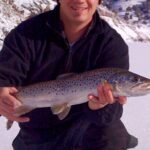
The undisputed headliner at Freedom Park Pond right now is the Triploid Rainbow Trout. Thanks to a highly aggressive spring planting schedule executed by the Idaho Department of Fish and Game, this compact 0.9-acre waterbody is absolutely teeming with active fish. Over 3,500 catchable-sized rainbows were introduced in the weeks leading up to the current season, including a significant batch of premium 12-to-14-inch fish. Because these are triploid trout—meaning they are sterile—they do not expend energy on spawning activities. Instead, their caloric intake goes directly into rapid growth and aggressive foraging. These freshly stocked trout are highly active, constantly cruising the pond in search of high-protein meals to sustain their elevated metabolism in the warming spring waters.
🎣Nautrek
Private Beta
J
M
R
100+ anglers on the waitlist
The fishing network where your reputation matters.
Find trusted captains, join real trips with cost splitting, and build your Angler Rank. Your spots stay private — you decide who sees your intel.
While the crowds are hyper-focused on soaking dough bait for rainbow trout, the astute angler should not overlook the Greengill hybrid. A cross between a green sunfish and a bluegill, these panfish possess the aggressive predatory nature of the green sunfish combined with the schooling behavior of a bluegill. They are pushing toward the shallower margins as the sun warms the upper water column. They offer fantastic light-tackle action and are often entirely ignored by the standard trout crowd.
Baitfish and Forage Report
In a compact community pond environment, the forage base is heavily skewed toward aquatic invertebrates rather than large baitfish. The trout are currently keyed in on midges, emerging mayflies, and small terrestrial insects blown onto the water's surface from the surrounding park. Additionally, juvenile panfish fry and tiny minnows are present near the shoreline vegetation. Matching your presentation to these smaller, natural food sources is the key to triggering strikes from both fresh stockers and holdover fish.
TACTICAL STRATEGY
Where to Deploy
Freedom Park Pond may be small at just under an acre, but it features distinct zones that dictate fish movement throughout the day. Early in the morning, focus your efforts on the shallower margins near the vegetation lines where the water warms fastest. As the sun climbs and UV penetration increases, the trout will push toward the deeper central basin to find cooler water. Position yourself on the western bank and cast toward the middle drop-off. The transition zone where the shallow flat dips into the central bowl is a prime ambush point for cruising 14-inch rainbows.
Lure and Bait Selection
Lures: Ultralight gear is mandatory. For artificial presentations, a 1/16 oz or 1/8 oz inline spinner is highly effective. Specifically, a Panther Martin with a black body and yellow spots is a proven killer on these local trout. Alternatively, a 1/8 oz Kastmaster spoon in a silver and blue pattern mimics the flash of small fry and allows for long, aerodynamic casts.
Color Theory: Stick to high-contrast colors. The black and yellow combination provides an excellent silhouette against the sky when fish look up from the bottom, while metallic silver capitalizes on the bright, sunny conditions to reflect maximum light.
Bait: If you prefer soaking bait, the classic floating dough bait remains undefeated. Rig chartreuse or garlic-scented PowerBait on a sliding egg sinker rig. Use a 1/4 oz slip sinker above a small barrel swivel, followed by an 18-inch leader of 4lb fluorocarbon tied to a #10 single egg hook. The fluorocarbon is critical in this clear water, and the 18-inch length ensures your bait floats perfectly above the bottom debris.
Optimal Timing
The golden hours remain the most productive windows. Plan your primary attack for the first two hours after dawn or the final two hours before sunset. During these low-light periods, the trout are less cautious and will actively hunt near the surface. If you are restricted to fishing mid-day, slow down your presentation, downsize your baits, and keep your rigs pinned near the bottom.
Pro Tip:When retrieving spinners, vary your speed. A steady retrieve catches fish, but adding a sudden pause-and-flutter mimics a dying minnow and often triggers violent reactionary strikes from following trout.
REGULATIONS SNAPSHOT
Compliance is just as important as technique. Freedom Park Pond falls under the general Idaho state fishing regulations for community ponds, designed to maximize harvest opportunity while maintaining a healthy fishery.
Species
Daily Bag Limit
Size Restrictions
Season
Trout (Rainbow, Triploid)
6 per day
None
Year-Round
Panfish (Greengill, Bluegill)
None
None
Year-Round
Bass (Largemouth, Smallmouth)
6 per day
None
Year-Round
Always ensure you possess a valid Idaho fishing license before wetting a line. Remember that while resident youth under 14 can fish for free and maintain their own separate bag limit, non-resident youths under 14 must be accompanied by a licensed adult, and their catch is included in the adult's limit unless the youth purchases a separate license.
Pro Tip:Community ponds experience high angling pressure throughout the spring. Practice ethical angling by properly disposing of all discarded fluorocarbon line, hook packages, and bait containers to keep the park pristine.
REGIONAL ALTERNATIVE
If you arrive at Freedom Park Pond and find the banks too crowded, or if the bite is inexplicably shut down, pivot your operation to the nearby Snake River below Milner Dam, located just a few miles away.
Location & Access: The Milner Lake and Snake River stretch offers expansive public access points away from the urban crowds. Head toward the Milner Gooding Canal area or the main river channel access points.
Target Species: This larger river system provides excellent opportunities for aggressive Smallmouth Bass and larger, holdover Rainbow Trout.
Tactical Approach: Swap your ultralight gear for a medium-light setup capable of handling heavier current. Throw 1/4 oz crawfish-patterned crankbaits or bounce 1/8 oz green pumpkin tube jigs along the rocky shorelines and current seams. The smallmouth will be holding tight to the rocky structure waiting to ambush prey caught in the flow. For the trout, drifting a nightcrawler under a slip bobber along the eddy lines is a highly reliable tactic that keeps your bait in the strike zone longer.
Tight lines!
Editor's Choice: Must-Have Gear
FISHINGSIR Next-Gen Waterproof Chest Waders
★★★★★4.4 (7,370+ reviews)
2-Ply Tech: Upgraded nylon with 2.5x higher density than standard fabrics.
100% Waterproof: Lab-approved intrusion resistance with taped visible seams.
Ultra-Lightweight: Designed for all-day comfort while hunting or fishing.
As an Amazon Associate I earn from qualifying purchases. #ad
🐟Freedom Park Idaho
Species data is being updated for this location.
Check back soon for fishing forecasts.
Live Fishing Conditions: Tides, Weather & Waves
Get real‑time tides, marine weather, swell and solunar activity for each spot so you know exactly when conditions line up for your best chance at a bite.
🎣
Freedom Park Idaho
Loading coordinates...
🌤️
WEATHER CONDITIONS
--°F
--°C
Loading...
🌡️
Feels Like--°F--°C
💧
Humidity--%
💨
Wind-- mph-- km/h
🧭
Direction--
📊
Pressure-- inHg-- hPa
☀️
UV Index--
🌊
MARINE CONDITIONS
🌊Wave Height
-- ft
-- m
Loading...
🧭Wave Direction
--°
Loading...
⏱️Wave Period
-- s
Loading...
📈Tide Status
-- ft
-- m
Loading...
🌙
LUNAR & SOLUNAR
🌕
Loading...
Illumination: --%
Major Period--:-- - --:----:-- - --:--
Minor Period--:-- - --:----:-- - --:--
🌅Sunrise--:--
🌇Sunset--:--
📅
24-HOUR FORECAST
Loading fishing conditions...
Fishing Spots Map
🎣
Book a Fishing Charter near Freedom Park Idaho Fishing Report Today 🎣
Local guides & charters. Verified captains, instant booking, best price guaranteed.
There was an error loading the map. Please try refreshing the page.
Info
Local Access & Facilities
Situated in the heart of the Magic Valley, Freedom Park serves as a strategic gateway to the Snake River’s diverse fishery. This location offers anglers a unique blend of high-desert scenery and productive water, characterized by basalt cliffs, sagebrush plains, and deep river channels. The area is a transition zone where the river widens, creating opportunities for both power boating and technical shoreline stalking.
The atmosphere here is distinctly rugged yet accessible. While the park itself provides a manicured urban interface in Burley, the surrounding waters quickly shift into the wilder, historic landscapes of the Oregon Trail. The river bottom here is often rocky, requiring careful navigation, but the structure holds excellent populations of game fish. The prevailing high-desert climate means mornings can be crisp even in summer, and the wind is a constant variable that seasoned captains learn to use to their advantage.
For the serious angler, the primary draws here are Rainbow Trout and Largemouth Bass, with significant populations of Crappie and Yellow Perch available in the impoundments. The Snake River system here is managed heavily for irrigation, meaning water levels can fluctuate, altering holding pockets and accessibility. Understanding the interplay between the Minidoka Dam flows and the river current is the key to unlocking the bite in this section of Idaho.
Access & Getting There
Accessing Freedom Park and the surrounding Snake River fisheries is straightforward via Interstate 84. Most anglers will approach through the city of Burley. Traffic is generally light compared to major metropolitan areas, but agricultural machinery on secondary roads can slow transit times during harvest seasons. The primary launch facilities are located directly within the Burley area, with additional strategic access points upstream and downstream.
For those looking to launch larger vessels, the local ramps are generally well-maintained concrete structures. However, river levels are dictated by the Bureau of Reclamation. During late summer drawdowns, the end of the ramp may approach quickly; visual inspection before backing down is mandatory. The Milner Historic Recreation Area, located approximately 11.5 miles west, offers two boat ramps. One includes a dedicated kayak/canoe launch, ideal for those looking to fish the rocky shorelines quietly.
💡 Captain's Tip: RV Clearance Warning
If you are hauling a fifth-wheel or driving a tall recreational vehicle to the Milner Historic Recreation Area, use the West Entrance. The East Entrance has low clearance that has claimed many A/C units and rod tips. Approach with extreme caution.
Weather is the single biggest logistical challenge in this region. The open sagebrush topography offers little resistance to wind. When winds exceed 15 mph, the chop on the wider sections of the Snake River and Lake Walcott can become hazardous for smaller aluminum boats. It is advisable to launch early in the morning before the thermal winds kick up, typically around 11:00 AM.
Parking at Freedom Park and nearby access points like Milner is generally adequate, though summer weekends fill the lots by mid-morning. Security is standard for public areas; keep valuable tackle out of sight. For truckers or those towing heavy rigs, the Truck Parking Club in Heyburn (1.1 miles away) offers 24-hour access, which is a rare amenity for traveling tournament pros.
Freedom Park Idaho Pre-Trip Checklist
Facilities & Amenities
The infrastructure around Burley is robust enough to support a multi-day fishing campaign, but specialized gear can be scarce immediately on the water. Anglers should be aware that while there are general stores nearby, specialized tackle shops are not located directly at the ramp. Dry Creek Outfitters, located roughly 20 miles away in Murtaugh, is a reliable resource for live bait and specific regional tackle, but it requires a detour. It is highly recommended to stock up on specific crankbaits and soft plastics before hitting the dawn patrol.
💡 Captain's Tip: Fuel Logistics
There are no commercial fuel docks readily available on this stretch of the river. Top off your tanks at highway stations in Heyburn or Burley before launching. Running out of gas in the canyon sections can result in a long, difficult drift.
Lodging options cater well to the traveling angler. For those towing boats who prefer a roof over their heads, the Albion Campus Retreat offers solid accommodations about 12 miles out. For campers, the region offers several developed sites. Lake Cleveland Campground provides a high-elevation escape, while Milner Historic Recreation Area offers 26 campsites with moderate development, including fire rings and vault toilets. Note that Milner has no water or electric hookups, so come prepared for dry camping.
The table below details key facilities for logistical planning:
Facility Name
Type
Distance
Key Notes
Truck Parking Club
Parking
1.1 miles
Open 24/7; RV/Trailer friendly.
Milner Historic Rec Area
Campground/Ramp
11.5 miles
2 ramps; $15 camping fee; No hookups.
Lake Walcott State Park
Campground/Ramp
17.2 miles
Dump station; Flush toilets; Fee area.
Dry Creek Outfitters
Bait Shop
20.4 miles
Open 9AM-5PM; Closed Sat/Sun.
Permits, Regulations & Fees
Navigating the regulations in this area requires attention to detail, as jurisdiction overlaps between state and federal agencies. The Idaho Department of Parks and Recreation and the U.S. Fish and Wildlife Service jointly manage key areas. A valid Idaho fishing license is mandatory for all anglers. While Freedom Park itself is open, nearby hotspots have specific fee structures. The Milner Historic Recreation Area is a federal fee site, charging a $5 day-use fee and $15 per night for camping.
Conservation is a critical theme here, particularly near the Minidoka National Wildlife Refuge. This area was established by President Theodore Roosevelt specifically for bird protection. Consequently, there are strict seasonal closures to prevent disturbing nesting waterfowl. Boat fishing on Lake Walcott is heavily restricted and is generally only permitted from April 1 through September 30 in designated areas. Outside of this window, the water is closed to boats to protect migrating birds.
💡 Captain's Tip: Seasonal Boat Closure
Do not attempt to launch a boat on Lake Walcott between October 1 and March 31. The ramp may look inviting, but federal regulations are strictly enforced to protect waterfowl. Bank fishing remains open year-round in specific zones.
Anglers should also respect the Oregon Trail history embedded in the landscape. The ruts visible at Milner are protected historical resources. Walking off designated paths or disturbing the soil in these heritage zones is prohibited. Additionally, always clean, drain, and dry your boat to prevent the spread of invasive species, a major concern for the Bureau of Reclamation managing the dams.
Events & Seasonal Information
The fishing calendar in the Magic Valley is dictated by the seasons and irrigation flows. Spring (April-June) sees the water warm up and the bass move into the shallows near the shoreline willows and cattails. This is the prime time for throwing reaction baits. The opening of the boat fishing season on Lake Walcott on April 1st is a significant date on the local calendar, often drawing a surge of anglers looking to tap into unpressured fish.
Summer brings heat and heavy recreational traffic near the Burley boat docks. Serious anglers often shift to night fishing or extremely early mornings to avoid the wake boats and jet skis. The aquatic vegetation peaks in late summer, requiring weedless presentations for bass. Trout fishing remains consistent in the deeper river channels where the water remains cooler.
Winter turns the region into a harsh, windy landscape. While ice fishing is popular on some Idaho reservoirs, the river currents near Freedom Park can make ice unstable. The Minidoka Ranger District offers winter sports, but for the open-water angler, the window narrows significantly between November and March. Always check the wind forecast; a 20 mph wind across the high desert feels significantly colder and cuts through standard gear.
Contact Information & Resources
For the most current conditions, water levels, and regulatory changes, direct contact with managing agencies is recommended. The Bureau of Land Management (BLM) Burley Field Office manages the Milner area and can be reached at 208-677-6600. For specific inquiries regarding the wildlife refuge and Lake Walcott boating rules, contact the Minidoka National Wildlife Refuge at 208-436-3589.
Safety in this high-desert environment is the angler's responsibility. Cell service can be spotty in the canyon sections west of Burley. It is advisable to file a float plan with a contact on land. In case of emergency, the local Sheriff's department manages search and rescue operations. Always carry adequate water and sun protection, as the arid climate accelerates dehydration.
For precise locations, real-time weather conditions, and detailed bathymetry, consult the live dashboard and interactive maps below.
Our spot reports combine data-driven forecasts with curated local information. The forecast is generated by our proprietary Fishing Score algorithm (0–100%), which analyzes real-time data from Open-Meteo API, validated against NOAA CO-OPS tide gauges and USGS water-monitoring stations. The model weights tide dynamics (35%), wave energy (25%), wind patterns (20%) and time of day (20%)—factors shown to influence fish feeding behavior through marine-biology research and decades of charter log data.
Access, facilities and services information for each fishing spot is sourced from official datasets such as Recreation.gov (RIDB), state park & wildlife agencies, and geospatial providers like Google Maps. These sections undergo scheduled re-validation every 3–6 months to ensure that boat ramps, park access, contact details and local services remain accurate.
Narrative sections (catches, seasonal behavior, local tips) are synthesized from these data sources and refined following the Fishing Reports Today editorial guidelines, combining bibliographic research from ichthyology and oceanography with expert angler experience. Our team reviews reports on a regular basis, while the forecast model itself updates every 6 hours for real-time accuracy.
⚠️ Important: Always verify current local regulations, access restrictions and weather conditions before fishing. These reports are intended as a planning aid, not a guarantee of catches or safety. When in doubt, contact local authorities or park managers listed on the page.
To provide the best experiences, we use technologies like cookies to store and/or access device information. Consenting to these technologies will allow us to process data such as browsing behavior or unique IDs on this site. Not consenting or withdrawing consent, may adversely affect certain features and functions.
Functional Always active
The technical storage or access is strictly necessary for the legitimate purpose of enabling the use of a specific service explicitly requested by the subscriber or user, or for the sole purpose of carrying out the transmission of a communication over an electronic communications network.
Preferences
The technical storage or access is necessary for the legitimate purpose of storing preferences that are not requested by the subscriber or user.
Statistics
The technical storage or access that is used exclusively for statistical purposes.The technical storage or access that is used exclusively for anonymous statistical purposes. Without a subpoena, voluntary compliance on the part of your Internet Service Provider, or additional records from a third party, information stored or retrieved for this purpose alone cannot usually be used to identify you.
Marketing & Affiliates
The technical storage or access is required to create user profiles to send advertising, or to track the user on a website or across several websites for similar marketing purposes, including affiliate tracking for products recommended in our reports.
Leave a Reply